Credit Portfolio Management

Mathematical Representations of Credit Portfolio Data

Mathematical Representations of Credit Portfolio Data

What do we mean by credit data? This post is a discussion around mathematical terminology and concepts that are useful in the context of working with credit data, taking us from network graph representations of credit systems to commonly used reference data sets

Reading Time: 1 min.

Course Objective

Digging into the meaning of credit data collections, the logic that binds them together towards understanding what they can be used for and what limitations and issues they may be affected by, this new course in the Credit Portfolio Management category explores a new angle to look at an old practice.


Intro to Credit Concentration

Reading Time: 0 min.
Visual representation of credit concentration diversification

Summary

This course is a Crash Program introduction to the topic of credit risk concentrations: how to identify, measure and manage excess credit exposure, an essential risk management discipline for any credit portfolio.

Content

The course covers the following topics:

Loan Level Templates Using Python

Reading Time: 0 min.
Python is the swiss knife of modern programming languages and a prime candidate to be also the swiss knife for risk modelling

Summary

This course is a CrashProgram in the use of python for credit portfolio modelling purposes, in particular working with data templates and spreadsheets.

Content

The course covers the following topics:

Credit Migrations using TransitionMatrix

Reading Time: 1 min.
Python is the swiss knife of modern programming languages and a prime candidate to be also the swiss knife for risk modelling

Summary

This course is a CrashProgram (short course) in the use of Python and the package TransitionMatrix for analysing credit migration data.

Requirements

The course is at a medium technical level. It requires some familiarity with python (and a working installation that includes the common numpy/scipy libraries). On the risk modelling side it requires knowledge of basic credit rating migration concepts.

Managing Loan Portfolios Using MongoDB

Reading Time: 1 min.
Python is the swiss knife of modern programming languages and a prime candidate to be also the swiss knife for risk modelling

Summary

This course is a CrashProgram in the use of the MongoDB database in conjunction with Python for credit portfolio management purposes.

Content

The course covers the following topics:

Risk Data Review

Reading Time: 1 min.
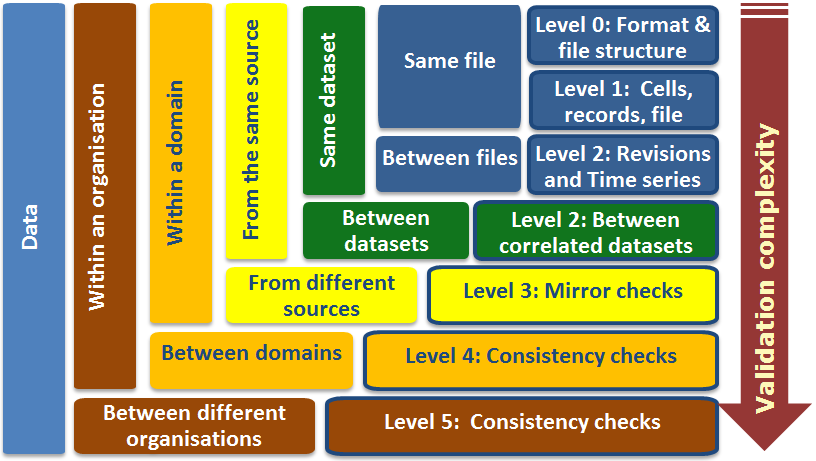
Different data validation levels as recommended by Eurostat

Summary

This course is a CrashProgram (short course) introducing the concept of a structured review of risk data.

Outcomes

Step by step we build the knowledge required to review the suitability of data for a given purpose and how to report the findings.

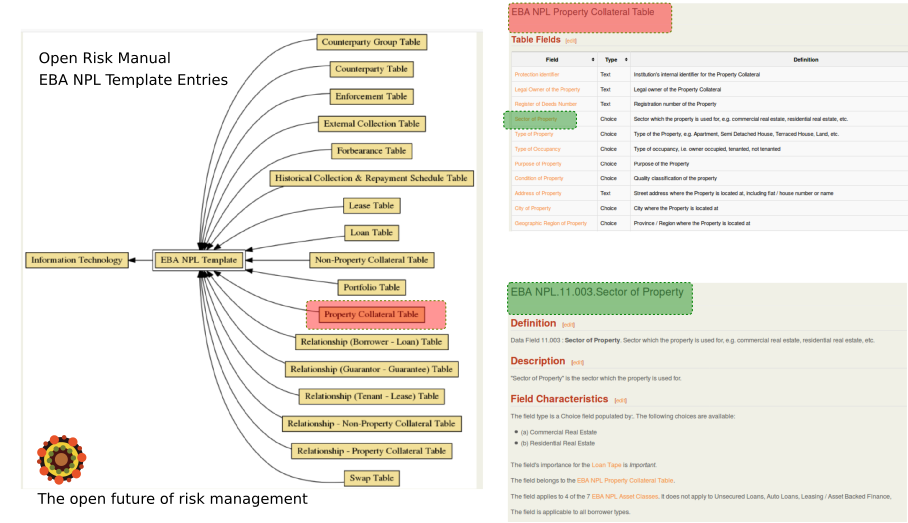
Introduction to the EBA NPL Templates

Introduction to the EBA NPL Templates

Reading Time: 3 min.

Summary

The Open Risk Academy course NPL270672 is a CrashCourse introducing the EBA NPL Templates.

Content

We start with the motivation for the templates and the domain of credit data (to which NPL data belongs). We discuss three core classes that capture the essence of lending operations from a lenders point of view (Counterparty, Loan, Collateral). Next we explore classes that capture events in the lending relationship lifecycle (which we term NPL Scenarios). We look into the main data types: elementary data types, choice lists, arrays and unstructured text. We close with discussing some more complex issues involving graph and timeseries data.