The Green Public Procurement Challenge (Online Game)
In this post we introduce a new online game that aims to familiarise with various challenging aspects of Green Public Procurement
Motivation
The substantial potential of Green Public Procurement towards achieving sustainability objectives is well known. But the transition process involves significant complexity and implementation barriers. The combination of diverse categories of products and services, each with their own specific sustainability profiles and data/knowledge requirements and the need for augmented organizational capacities to handle expanded information flows is a formidable challenge. In a new and free online game we introduce some aspects of these challenges in a simplified, fun setting that helps highlight some of the considerations involved.
Sustainability.Town
The GPP challenge game is hosted in the sustainability.town, an online platform dedicated to hands-on demonstrations and applications of Sustainable Portfolio Management concepts and methodologies. It is part of a new series of serious games covering a wide range of important concepts in an engaging manner.
Gameplay
In the game the (single) player assumes the role of a public procurement manager working for a large city. The gameplay imagines our intrepid public servant (namely, you!) inheriting a challenging procurement portfolio that has a substantial environmental footprint (in terms of excess Greenhouse gas emissions).
The general objective of the game is to use the next procurement season to reduce the city’s environmental impact by making optimal choices when various procurement tenders materialize.

Alas, inherited a challenging procurement portfolio. It keeps the great city of ours ticking, but needs some shrewd interventions if it is meet its sustainability goals. Your composite objective is to reduce Greenhouse gas emissions from procured goods and services, even while fulfilling all the city’s procurement needs and staying within budget and of course delivering everything on time!
For each tendering process you will need to pick wisely from the available bids as those land on your desk. You need to reduce your carbon footprint while keeping an eye on the costs of alternative proposals. Like in real life, pursuing sustainability is not a simple exercise. The procurement officer must meet the city’s procurement needs across different product categories (here, six major sectors) with a limited budget and within a limited time. This requires careful evaluation and selection from among the various bids.
Landing Scene
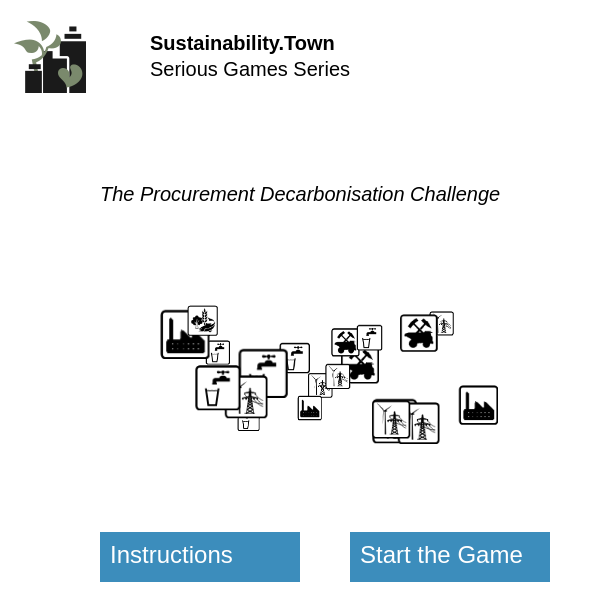
The landing scene for the game provides you with the option to refresh briefly the instructions or start playing the game. Once you press start the time starts running, so be sure to be ready!
Time Management
Like in real life, managing time is of the essence. Game time is displayed at the top of the screen as a diminishing blue bar. Once the time runs out, it is game over and your performance will be evaluated.

Having said that, don’t panic, you should aim for a steady pace to work through the procurement needs.
Budget Management
After the lapsing of time, the next critical resource you need to keep an eye on is your budget. This is shown as a reddish bar at the top.
You need to cover the needs of your city with the available money. Once the money runs out it is again game over, as it is not possible to fulfil any other procurement needs.

Fulfilling procurement needs always costs money, doing so with less environmental impact might cost more (but not always).
Procurement Needs
The Procurement Needs for each category of product (sector) are the blue horizontal bars that tell you how much is needed for the current year (in product units).
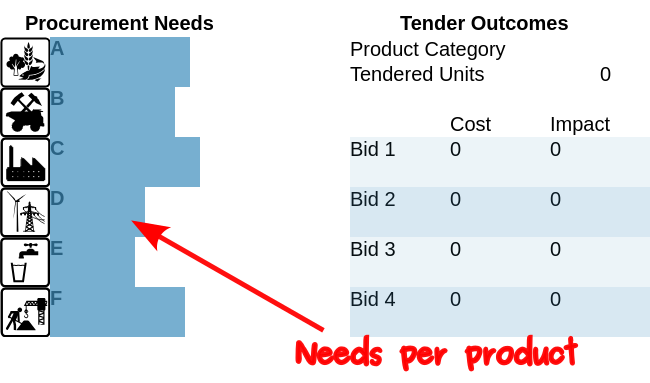
We imagine that all goods and services we need to procure are grouped in six sectors:
- Agricultural products (A)
- Raw materials (B)
- Manufactured products (C)
- Electricity (D)
- Water and Sewage (E)
- Construction (F)
For each new game there is a random assignment of needs per sector.
The Tender Process
Each successful tender in a sector category reduces the needs for that product. The target is to reduce to the needs to zero for all sectors within the allotted time. The total remaining needs are indicated on the top right hand side as a percentage, to give you a feel how well you are doing in this respect overall.
You start the tendering process by pressing the New Tender button.
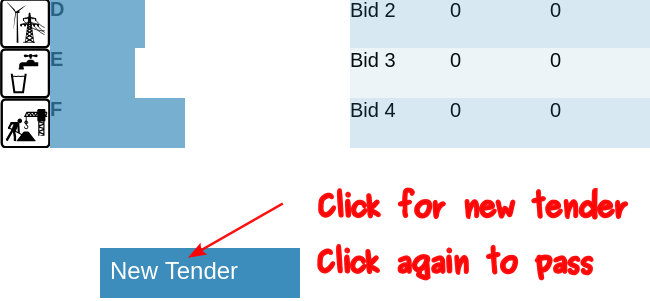
The product/sector that is to be procured in the next round is picked at random, from the categories that still have ongoing procurement needs. This is to simplify the gameplay - but also illustrates the chaotic order in which procurement needs might need to be fulfilled!
Pressing the New Tender button triggers the biding process. The amount of product that will be available in the market will vary. This emulates market volatility and other constraints.
Evaluating the Available Bids
For each tendering process there are always four bids to choose from. They differ in cost and environmental impact per unit.
Cost is the cost per product unit, which is multiplied by the number of units to produce the total cost. For the selected bid, this total cost will be subtracted from your budget.
Impact is the environmental impact (here imagined as GHG emissions per unit). This is multiplied by the number of units and added to your running footprint profile.
Let us look closer at an example:
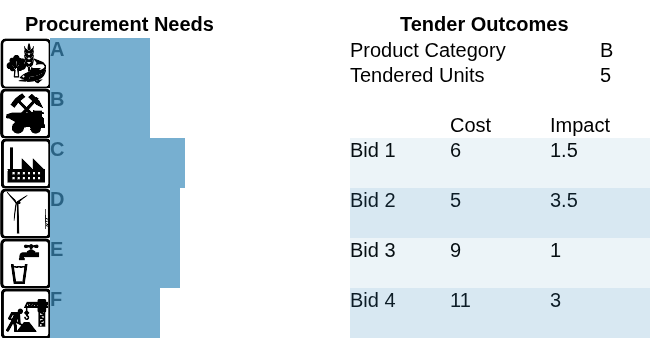
We see that the sector selected in this round is B, raw materials. There bids concern 5 units of raw materials. The bids that came in range in cost from 6 to 11 per unit (in some currency). They also range in environmental impact between 1 and 3.5 per unit (in some impact metrics).
We have the following options:
- Pass on all bids (by pressing New Tender)
- Selecting a Bid by Clicking anywhere in its row.
If we select a bid, the game immediately calculates the side-effects
- reducing the procurement needs for that sector (here it would be B, raw materials, reduced by 5 units)
- adjusting the budget: e.g. E.g., if we selected Bid 3, we’d pay 45 currency units
- adjust the environmental footprint. E.g. if we selected Bid 3 the impact is 5 units, which is compared against the average of the hypothetical previous season.
NB: You can reject all bids and ask for a new tender as many times as you like. But besides losing time, this reduces your market savvy score.
Environmental Impact Reduction
Your starting condition is assumed to be the cumulative environmental impact of the last procurement season. This is indicated with the brown bar. Your environmental target for the new season is indicated with the green portion. The objective is to eliminate the brown part!
Strategy
Well, that is your job to figure out! Observe what happens and adjust your choices accordingly. In contrast to real life, you can play the game as many times as you want.
Final Performance Evaluation
The game ends if you run out of time or money or (if you’ve become a procurement expert) if you managed to fulfill all needs.
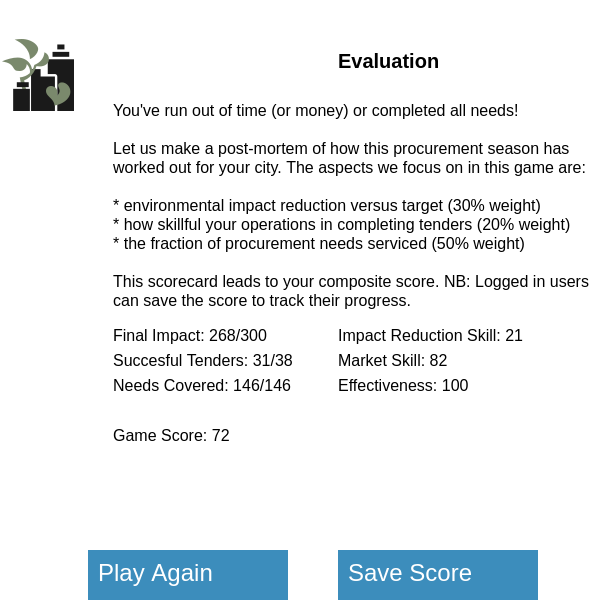
Once the game ends you are shown the evaluation screen. Here you are presented with a post-mortem of the procurement season.
The aspects being highlighted (and scored) are game are:
- the degree of environmental impact reduction versus target (30% weight in the score)
- how skillful your operations in completing tenders (20% weight in the score)
- the fraction of procurement needs serviced (50% weight in the score)
The scorecard with the above indicated weights combines the different performance metriics and that leads to your composite score.
NB: Logged in users can save their score to track their progress.
Simplifications
To reduce the complicated green public procurement process to a simple game requires some pretty drastic simplifications.
Even an enumeration of all simplification would be a very long list! Maybe an obvious one, in terms of realism, is that in order to simplify the gameplay, all product units are normalized and treated as homogeneous. In practice procurement officers must be intimate with the details of each and every product and service.
Nevertheless, in comparison with Public Procurement that does not take environmental impact into account, the game illustrates the important complexity of managing multiple objectives.
Go ahead, play the game and tell us what you think of it!
Comment
If you want to comment on this post you can do so on Reddit or alternatively at the Open Risk Commons. Please note that you will need a Reddit or Open Risk Commons account respectively to be able to comment!