A Digital Sustainability Competence Framework for Moodle
The EU Digital4Sustainability project tackles the challenge of transitioning into a sustainable, digitally enabled economy head on, creating a detailed competence framework that integrates digital and sustainability competences into fully-fledged educational programmes. In this post we explore how the Digital4Sustainability competence framework can be integrated into the Moodle Learning Management System.
Open Risk recently joined the Digital4Sustainability (D4S) Alliance community. In a previous blog post we explained the what and why in some detail. In this post we discuss how some of the deliverables of the D4S project can be integrated into a Learning Management System, in particular the Moodle instance that supports our Open Risk Academy
A Digital Sustainability Competences Framework for Moodle
For many people Moodle does not need an introduction but it might be worthwhile to summarize some key points about it. Moodle is a free and open-source learning management system. The server is written mostly in PHP and it is distributed under the GNU General Public License. Moodle is used worldwide for blended learning, distance education and other online learning projects in schools, universities, workplaces and other sectors, with almost multiple thousands of instances being online. Moodle was originally developed by Martin Dougiamas to help educators and scholars create online courses and focus on interaction and the collaborative construction of content. The first version of Moodle was released in 2002 (24 years ago!), and it continues to be actively developed.
Moodle is a learning platform used to augment existing learning programmes. As an E-learning tool, Moodle developed several features now considered standard for learning management systems. One such key feature is supporting Competency-based education. Competencies describe the level of understanding or proficiency of a learner in certain subject-related skills. The approach, also known as competency-based learning, or skills-based learning, refers to systems of assessment and grading where students demonstrate these competencies.
In Moodle it is possible to create and apply multiple such frameworks for evaluating students against competencies:
- Competency frameworks may be enabled and disabled by a Moodle instance administrator.
- Teachers / content creators can add competencies to courses and course activities.
- Administrators can create learning plan templates, then select competencies to add and finally assign learning plans to individuals or cohorts.
In practice a Moodle Competence Framework is a single CSV file, with its content formated in a specific way. Sample files are available within the demo Moodle instance. Our objective here is to develop a Moodle competence framework that encodes the competency structure developed by the Digital4Sustainability project. This is a project funded under the EU’s Erasmus+ programme to help accelerate the digital and green transitions (the so-called twin transition). The mission is to develop and implement innovative training programmes that provide professionals and businesses with the skills and knowledge needed in the rapidly evolving landscape of today, where digital technology and sustainability intersect in complex and non-trivial ways.1
Our objective here is to map and integrate D4S competency concepts into the Open Risk Academy, the eLearning platform that provides hands-on online eLearning courses in a variety of sustainability topics, and the Open Risk Manual, a comprehensive wiki documenting the target knowledge base. Developing a self-contained Moodle competence framework is one of the building blocks of this effort.
Leveraging the Digital Sustainability Competences Ontology
The starting point of our journey is a D4S Competences Ontology as discussed in a previous post. Such an ontology distills the structural and machine readable features of the overall D4S framework, i.e., the elements needed for producing a concrete CSV file as required by Moodle. The first iteration of the ontology can be explored interactively online here.
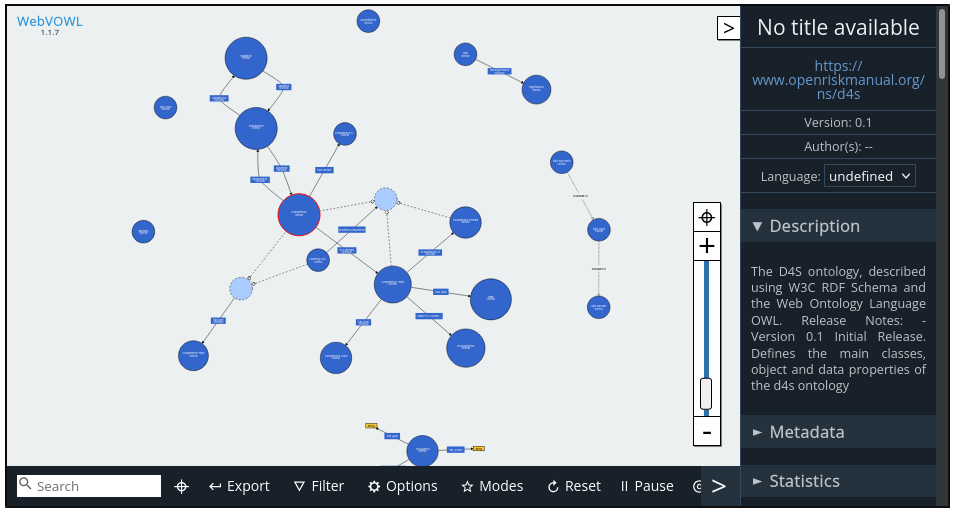
The information content we actually need to extract from the ontology is a subset of the overall concepts and their relations. But for it to be usable in an LMS context it must align in meaning and format. This is is what we will discuss next.
The Moodle Competence Framework Data Structure
The digital competences pillar of the D4S framework is primarily aligned with e-CF, the European e-Competence Framework2, which provides a reference for the competences required and applied at the Information and Communication Technology (ICT) workplace. The framework uses a common language for competences, skills and capability levels that can be understood across Europe. All D4S competences are mapped to e-CF competences, and the logical structure of the e-CF framework that is used can be summarized as follows:
- Level 1: Five Competence Areas, encoded in letters A-E in the table, derived from ICT business processes captured by the verbs Plan, Build, Run, Enable, Manage.
- Level 2: Circa 40 Reference Competences for each L2 area (as per above table), with a generic description for each competence.
The difficulty with using the e-CF Level 1 segmentation as-is is evident. It uses a process-oriented language that is more abstract than commonly used internally in organizations. While it has the advantage of highlighting intrinsic attributes of a competency, it might be less recognizable as a relevant collection of competences3.
Another approach to top-level classification, that is indicated in the D4S documentation and we adopt for use in the Open Risk Academy is identifying the following set of practice domains:
| Domain ID | Description |
|---|---|
| ‘D4S.DOM.1’ | ‘Data and Analytics’ |
| ‘D4S.DOM.2’ | ‘Measurement and Analysis’ |
| ‘D4S.DOM.3’ | ‘Policy and Compliance’ |
| ‘D4S.DOM.4’ | ‘Strategy and Management’ |
| ‘D4S.DOM.5’ | ‘Technology and Infrastructure’ |
A similar usability issue arises with the Level 2 e-CF competences which resolve each one of the Level 1 competence domains. A sample of these is given below:
| e-Competence | Description |
|---|---|
| A.1 | Information Systems and Business Strategy Alignment |
| A.2 | Service Level Management |
| A.3 | Business Plan Development |
| A.4 | Product / Service Planning |
| A.5 | Architecture Design |
| A.6 | Application Design |
| A.7 | Technology Trend Monitoring |
| A.8 | Sustainable Development |
| A.9 | Innovating |
| B.1 | Application Development |
| B.2 | Component Integration |
| B.3 | Testing |
The issue is that the direct focus of e-CF on pure ICT competences (which is the objective of e-CF after all!) is not descriptive enough for the corresponding D4S competences that exist within a sustainability context4. Even though all of D4S competences are mapped to one or more e-CF competences, as per the Level 1 discussion, this mapping highlights only one aspect of a given competency.
A more intuitive approach we adopt here is to align Level 2 competence topics with the D4S programme level deliverables. The complete list of such Level 2 competencies goes as follows:
| e-Competence | Description |
|---|---|
| D4S.DOM.1.PLO.1 | Conduct Sustainability Data Analysis |
| D4S.DOM.2.PLO.2 | Support ESG Data Collection and Quality Control |
| D4S.DOM.1.PLO.3 | Create Data Visualisations and Dashboards |
| D4S.DOM.3.PLO.4 | Prepare CSRD and ESG Regulatory Reports |
| D4S.DOM.1.PLO.5 | Perform Statistical Analysis for Sustainability |
| D4S.DOM.1.PLO.6 | Maintain Data Quality and Integrity |
| D4S.DOM.1.PLO.7 | Apply Data Analytics Tools |
| D4S.DOM.3.PLO.8 | Communicate Insights and Support Governance |
| D4S.DOM.5.PLO.1 | Architect Data Analytics Infrastructure for Sustainability |
| D4S.DOM.3.PLO.2 | Establish ESG Data Governance and Quality Frameworks |
| D4S.DOM.1.PLO.3 | Develop Advanced Analytics and Machine Learning Models |
| D4S.DOM.5.PLO.4 | Orchestrate Big Data Processing and Visualisation Strategy |
| D4S.DOM.5.PLO.5 | Monitor Technology Trends and Ensure Data Security |
| D4S.DOM.4.PLO.6 | Formulate Data-Driven Sustainability Strategies |
| D4S.DOM.2.PLO.7 | Conduct and Disseminate Sustainability Research |
| D4S.DOM.4.PLO.8 | Coordinate Data Projects and Lead Cross-Functional Teams |
| D4S.DOM.5.PLO.9 | Optimise Energy Efficiency in Data Operations |
| D4S.DOM.1.PLO.10 | Pioneer Advanced Analytics Innovation |
| D4S.DOM.4.PLO.1 | Assess Organisational Sustainability Maturity |
| D4S.DOM.5.PLO.2 | Design Digital Sustainability Solutions |
| D4S.DOM.4.PLO.3 | Develop Transformation Roadmaps |
| D4S.DOM.4.PLO.4 | Guide Stakeholder Engagement and Change |
| D4S.DOM.4.PLO.5 | Advise on Sustainability Frameworks and Standards |
| D4S.DOM.5.PLO.6 | Evaluate Emerging Digital Technologies |
| D4S.DOM.2.PLO.7 | Measure and Communicate Impact |
| D4S.DOM.4.PLO.1 | Formulate Digital Sustainability Strategies |
| D4S.DOM.4.PLO.2 | Orchestrate Sustainability Transformation Programs |
| D4S.DOM.4.PLO.3 | Steer Organisational Change and Culture |
| D4S.DOM.4.PLO.4 | Govern Digital Sustainability Initiatives |
| D4S.DOM.4.PLO.5 | Engage and Influence Stakeholders |
| D4S.DOM.2.PLO.6 | Measure and Demonstrate Impact |
| D4S.DOM.3.PLO.7 | Navigate Regulatory and Policy Landscapes |
| D4S.DOM.5.PLO.1 | Configure and Integrate Sustainability Platforms |
| D4S.DOM.5.PLO.2 | Maintain Systems and Equipment |
| D4S.DOM.5.PLO.3 | Troubleshoot Technical Issues |
| D4S.DOM.5.PLO.4 | Support Platform Users |
| D4S.DOM.5.PLO.5 | Manage Incidents and Documentation |
| D4S.DOM.5.PLO.6 | Maintain Technical Documentation |
| D4S.DOM.5.PLO.7 | Support Green IT Infrastructure |
| D4S.DOM.3.PLO.8 | Follow Professional Standards |
Individual competencies are in turn aligned with Unit Learning Outcome deliverables (too many to list here). With these choices and mappings it is straightforward to construct a hierarchy of competences and extract and shape from the ontology a file in CSV format.
Importing the D4S Competency Framework into Moodle
Importing the CSV file into Moodle can be done via the Web interface. Upon successful upload and integration it will show up in the list of available competence frameworks.
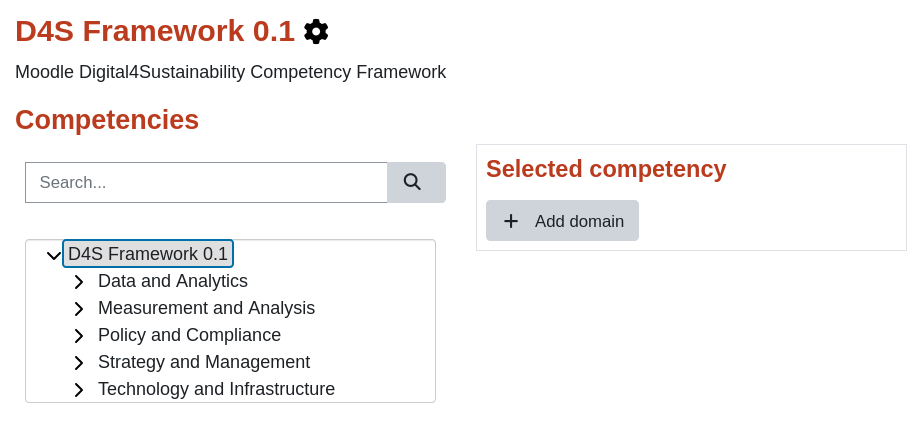
We can then immediately drill-down into the L2 and L3 competencies
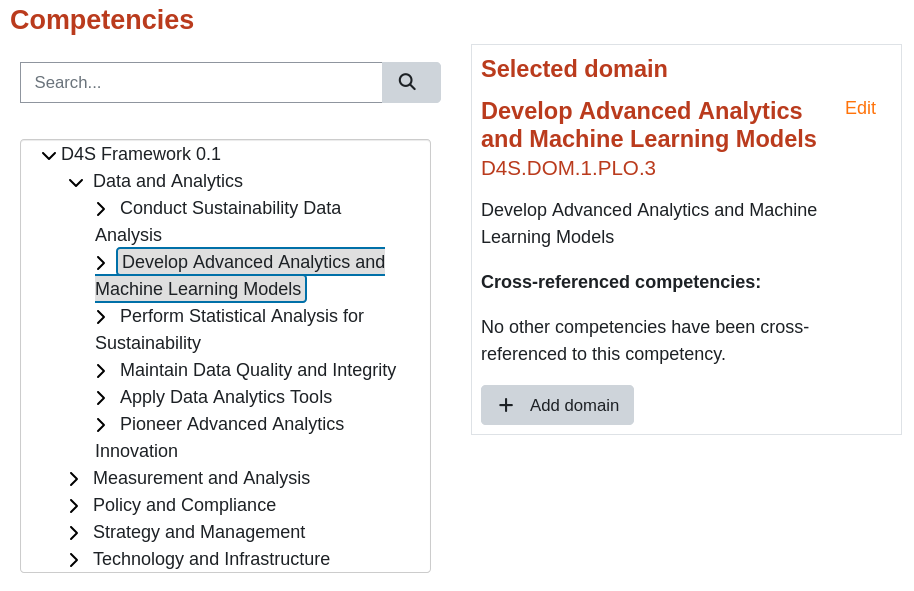
How we use it from here on depends of course on the eLearning resources provided by the Moodle instance.
Moodle Learning Plans
One way to use the Competence Framework is to structure digital sustainability profile requirements. The D4S project identifies five such representative educational profiles as follows:
- Data Analyst for Sustainability: The profile equips learners with skills to conduct sustainability data analysis and support regulatory reporting, for example by managing ESG data processes, developing sustainability KPIs, and ensuring data quality and governance.
- Data Professional for Sustainability: This profile prepares professionals to lead advanced data analytics, engineering, and science initiatives for sustainability.
- Digital Sustainability Consultant: This profile prepares professionals to provide expert advisory services on digital sustainability transformations, combining technical knowledge with consulting competences.
- Digital Sustainability Manager: This profile prepares professionals to lead organisational sustainability transformations, integrating digital technologies with strategic sustainability management.
- Sustainability Technical Specialist: This profile prepares learners to implement and maintain digital sustainability technologies, providing technical support for ESG platforms and environmental monitoring systems.
NB: While some of the competencies required by these profiles can be provided by online training, in general the educational resources and functionalities offered by an LMS will only cover a subset of what is required for a fully developed educational programme.
Download the latest version
The latest version of the D4S Competence Framework for Moodle is downloadable here in CSV format.
Notes and References
-
To Find Out More Visit the official Digital4Sustainability website where you can learn more about the Alliance Community and how you might get involved. ↩︎
-
e-CF: the European e-Competence framework ↩︎
-
If needed, Moodle’s ability to support multiple competence framework means that using several variations can be used to organize competences in different ways. ↩︎
-
The discrepancy grows larger the further removed a sustainability role is from pure IT responsibilities, e.g., accounting and auditing functions. Such roles have an increasingly digital footprint. ↩︎