Towards a Digital Sustainability Competences Ontology
The twin transition into a sustainable, digitally enabled economy requires significant transformations in educational programmes to equip individuals with many new or adapted competences. The EU Digital4Sustainability project tackles this challenge head on, creating a detailed competence framework. In this post we start exploring how this competence framework can be expressed as a semantic ontology.
Open Risk recently joined the Digital4Sustainability (D4S) Alliance community. In a previous blog post we explained the what and why in some detail. In this post we discuss how some of the deliverables of the D4S project can support the development of a Digital Sustainability Competences Ontology, the motivation for doing so and preliminary design decisions.
A Digital Sustainability Competences Ontology
First, some background. The Digital4Sustainability project is funded under the EU’s Erasmus+ programme1 to help accelerate the digital and green transitions (the so-called twin transition2). The mission is to develop and implement innovative training programmes that provide professionals and businesses with the skills and knowledge needed in the rapidly evolving landscape of today, where digital technology and sustainability intersect in complex and non-trivial ways.3 The D4S project deliverables proceed along six dimensions:
- A Comprehensive Digital Sustainability Skills Strategy: A collaborative roadmap providing concrete actions, milestones, and policy recommendations to address skills gaps and unlock net-zero emissions by 2050.
- Modular HE/VET Learning Programmes: Demand-led training curricula covering EQF levels 3 to 8, designed to equip the workforce with advanced digital and green competences*
- EU-Recognised Certifications: A stackable system of micro-credentials and certifications aligned with national frameworks to ensure the formal recognition of skills and facilitate professional mobility.
- Direct Workforce Training: The reskilling and upskilling of participants through urgent programmes for decision-makers and pilot sessions for emerging occupational roles.
- Ready-to-Use Resource Packages: Standardised, downloadable training materials and teaching resources to enable educational providers across the EU to rapidly adopt and deliver the new curricula.
- The European Digital Sustainability Skills Platform (EDSSP): A central hub to foster long-term collaboration, knowledge exchange, and best practice sharing between industry leaders and education providers
Our focus here is on dimensions 2 and 5 of the project which concern learning programmes and resource packages, with an objective to map and integrate related resources of the Open Risk Academy, the eLearning platform that provides hands-on online eLearning courses in a variety of sustainability topics, and the Open Risk Manual, a comprehensive wiki documenting the target knowledge base.
The role of Semantic Ontologies
Our ongoing focus at Open Risk has been developing digital capabilities (open source frameworks, eLearning resources and more) primarily targeting the domains of risk management and sustainable finance. An important part of the toolkit is the development of semantic web technologies. In a dedicated documentation page we list our currently developed and published ontology frameworks.
Semantic web ontology technologies are backed by decades of knowledge representation research in artificial intelligence. Tim Berners-Lee, the inventor of the World Wide Web, began advocating in the late 1990s for a Semantic Web, where metadata and structured meaning would be embedded in web documents. This vision requires a formal way to describe concepts and relationships between concepts. Broadly speaking, our task here is to encode certain elements of the D4S framework in a rigorous ontology framework that will enable a number of functionalities. Benefits from developing an ontology version of the D4S framework are:
- Portability: The entire knowledge base can be encoded in a single file.
- Machine Readability: Both logical structure and data elements can be parsed and be worked on programmatically.
- Modularity: Profiles, learning units, competences become interchangeable, logically well defined building blocks. This enables developing coherent combinations, identifying gaps etc.
- Integration: Established ontologies in related fields can be integrated, enriching the framework without raising the maintenance burden.
- Interoperability: In turn the framework can be integrated into other initiatives.
In principle various technologies can be the starting point for such an ontology. We have adopted the W3C’s Web Ontology Language (OWL). OWL is a Semantic Web language designed to represent rich and complex knowledge about things, groups of things, and relations between things. OWL documents, known as ontologies, can be published in the World Wide Web and may refer to or be referred from other OWL ontologies.
While there is a growing corpus of established ontologies relevant to occupations and competences, given that the D4S project is breaking new ground, there is presently no directly usable example. In fact, many of the relevant frameworks (e.g. various existing classifications of occupations and competences) are primarily focused on providing a taxonomic classification. While extremely useful in this context, taxonomies are but one component of a more fully developed ontology. Nevertheless, existing public competence frameworks provide important anchoring points for our target ontology. In this post we will visit a number of them, with the objective to identify the elements that we want to integrate.
The end product of a developed D4S competence ontology is essentially an information artifact (a file!). It integrates a subset of relevant data points (the types of concepts, the relations between concepts etc.) in a logically unambiguous manner. With appropriate software the ontology becomes effectively a flexible knowledge database that can be interrogated, augmented, shared etc.
greenComp: the European Sustainability Competence Framework
The starting point of our journey is the greenComp framework4, which is maybe the conceptually most profound of the frameworks we will discuss. greenComp seeks to identify the deeper changes in knowledge, skill and behaviors that will underpin the sustainability transition. For greenComp,

Structure
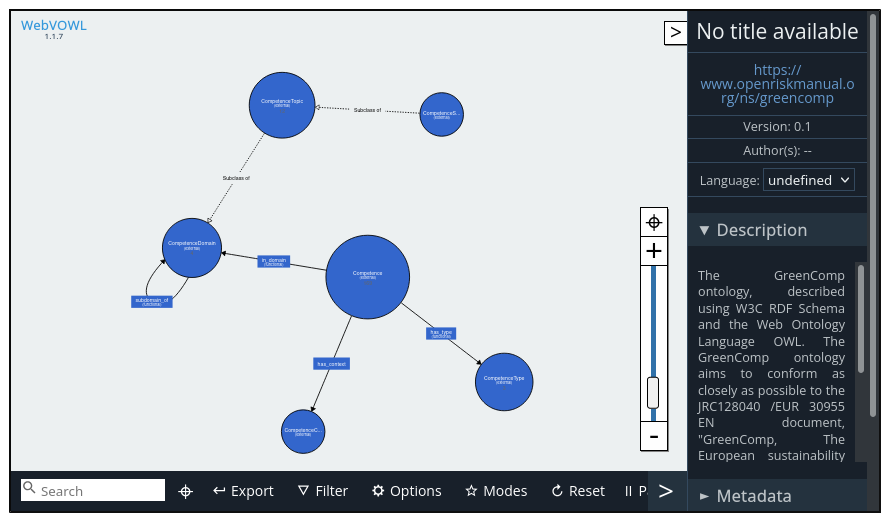
greenComp comprises four interrelated competence areas (domains):
- Embodying sustainability values
- Embracing complexity in sustainability
- Envisioning sustainable futures
- Acting for sustainability
Each area comprises three competence types that are interlinked and equally important. The labeling of all Competences along a KSA dimension indicates whether a Competence concerns Knowledge, Skill or Attitude and has important implications on how such competences can be developed and assessed. The logical structure of the greenComp framework can be summarized as follows
- Level 1: Four Competence Domains
- Level 2: 12-15 Competences or Statements
- 3 KSA Competence Types that are uniquely applied to each L2 competence
This structure can be readily converted into a simple ontology, where competences form a class hierarchy and a competence type is an object property.
Observations
- greenComp is a brand new competence framework (first launched in 2022). A first review of uptake is provided in 5.
- greenComp is focused on sustainability as defined above. As such it does not address the potential role of the digital domain, either as an enabler, or as an additional environmental footprint. Nevertheless besides setting the overall frame, it identifies important competences that overlap strongly and provide guidance for the development of digital capabilities. Indicatively under the domain of Embracing complexity in sustainability it highlights critical topics such as Life Cycle Analysis (LCA), and Complex Systems (synthesis, emergence, interconnectedness, feedback loops and cascade effects) that will play instrumental role in supporting informed decision making.
- The D4S competence framework is broadly aligned with greenComp, but the correspondence is not explicit in the D4S description of competences. Establishing that linkage requires the development of potentially further layers of the greenComp taxonomy.
- greenComp’s definition of sustainability is environmentally focused, anchoring itself on the concept of planetary boundaries. This point of view encompasses a wide range of environmental issues besides climate change and CO2 emissions. Each one of those (e.g., biodiversity, water usage, material flows) leads potentially to specializations in roles, knowledge and skills.
- greenComp does not cover social sustainability elements.
- There is no indication of the proficiency level that is required for difference competences. This is consistent with the more conceptual approach of the framework, which does not resolve into concrete tasks and occupational profiles.
e-CF: the European e-Competence framework
The digital competence pillar of the D4S framework is primarily aligned with e-CF. e-CF if the European e-Competence Framework6 which provides a reference for the competences required and applied at the Information and Communication Technology (ICT) workplace. The framework uses a common language for competences, skills and capability levels that can be understood across Europe. The e-CF was created for application by ICT service, user and supply companies, for managers and human resource departments, for education institutions and training bodies including higher education.
Indicatively, the core classification of the e-CF framework reads (showing only the first few competences):
| e-Competence | Description |
|---|---|
| A.1 | Information Systems and Business Strategy Alignment |
| A.2 | Service Level Management |
| A.3 | Business Plan Development |
| A.4 | Product / Service Planning |
| A.5 | Architecture Design |
| A.6 | Application Design |
| A.7 | Technology Trend Monitoring |
| A.8 | Sustainable Development |
| A.9 | Innovating |
| B.1 | Application Development |
| B.2 | Component Integration |
| B.3 | Testing |
Structure
The logical structure of the e-CF framework can be summarized as follows:
- Level 1: Five Competence Areas, encoded in letters A-E in the table, derived from ICT business processes captured by the verbs Plan, Build, Run, Enable, Manage.
- Level 2: Circa 40 Reference Competences for each L2 area (as per above table), with a generic description for each competence.
- Level 3: Samples of knowledge and skills related to e-Competences of Level 2. Adding value and context but not exhaustive.
- Proficiency levels of each e-Competence (e-Competence levels e-1 to e-5, which are related to the EU EQF levels 3 to 8).
Observations
- e-CF is a mature framework, focused on the ICT profession / sector, which it models in fairly granular detail. It provides less detailed coverage for digitally-adjacent domains: sectors, roles and competences where information technology is essential but does not constitute the primary economic activity (e.g., finance, data science etc.).
- The D4S competence framework is explicitly aligned with e-CF at the applicable classification level.
- The e-CF framework content licensing is restrictive, which means it is not re-usable in an ontology published, e.g., under a Creative Commons license.
- There is no KSA classification of competences (distinguishing e.g., IT knowledge from concrete IT tasks).
ESCO: the European Skills, Competences and Occupations Framework
ESCO is Europe’s comprehensive multilingual occupations classification system, developed by the European Commission to standardize how skills, competences, and occupations are described and categorized across Europe. ESCO is massive in size and deeply embedded in job matching (see Europass), recruitment, educational curriculum and qualifications design etc. A sample of what ESCO looks like is given in the following snapshot from the Open Risk Manual, which includes the entire taxonomy.
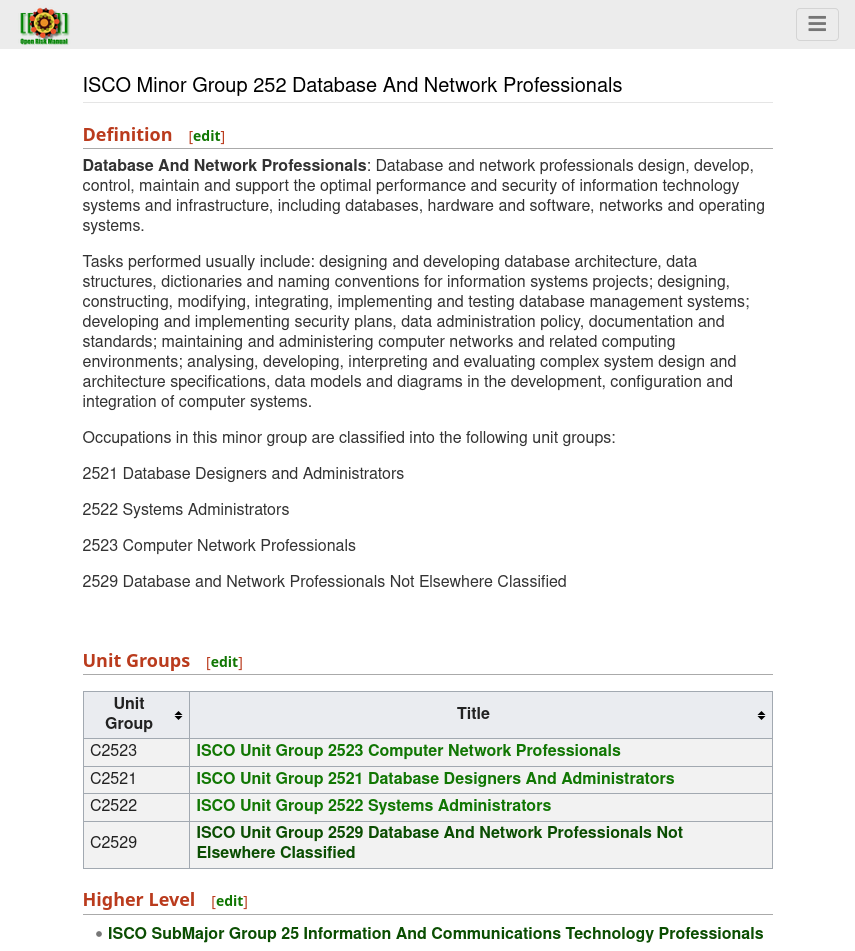
ESCO is aligned in the upper layers of the taxonomy with ISCO (the International Skills, Competences and Occupations framework). The ESCO classification stores information on almost 14,000 knowledge concepts and skills. A new idea of faceting or labelling skills and knowledge concepts was first applied with the release of ESCO v1.1.0, where the green label was introduced. A total of 591 ESCO skills and knowledge concepts are labelled as green. This includes 386 skills and 205 knowledge concepts. Work on labelling digital skills in ESCO has also started, with the integration of the European Digital Competence Framework for Citizens (DigComp) in the skills pillar of ESCO. A total of 1,201 digital concepts are already identified.
Structure
ESCO groups form the backbone of the classification structure and are aggregated based on their similarity in terms of the skill level and skill specialization required for the jobs. The overall taxonomy looks as follows:
- Multilayer Occupations Taxonomy (2942 Total Descriptions in v.1.0.9)
- 10 Major Groups
- 43 SubMajor Groups
- 130 Minor Groups
- 436 Unit Groups
- 1701 Occupation Descriptions
- 1241 Specialization Descriptions
- Groups have associated Tasks
- A Separate Skills Taxonomy
- Occupations have associated Skills, Knowledge and Attitudes (also Language Skills as a separate category)
- Skills and Knowledge are labelled as Essential or Optional
Observations
- ESCO provides a comprehensive taxonomy of Occupations and their required Competences (also KSA labelled). In this context the D4S framework provides conceptually a delta, an increment to the existing ESCO framework, namely it constitutes an identification and detailed specification of emerging digital sustainability occupations and competences. Importantly, D4S defines and links roles to the required learning programmes and qualifications.
- The Green and Digital labels of ESCO concepts are a unique new feature which provide additional relevant data points.
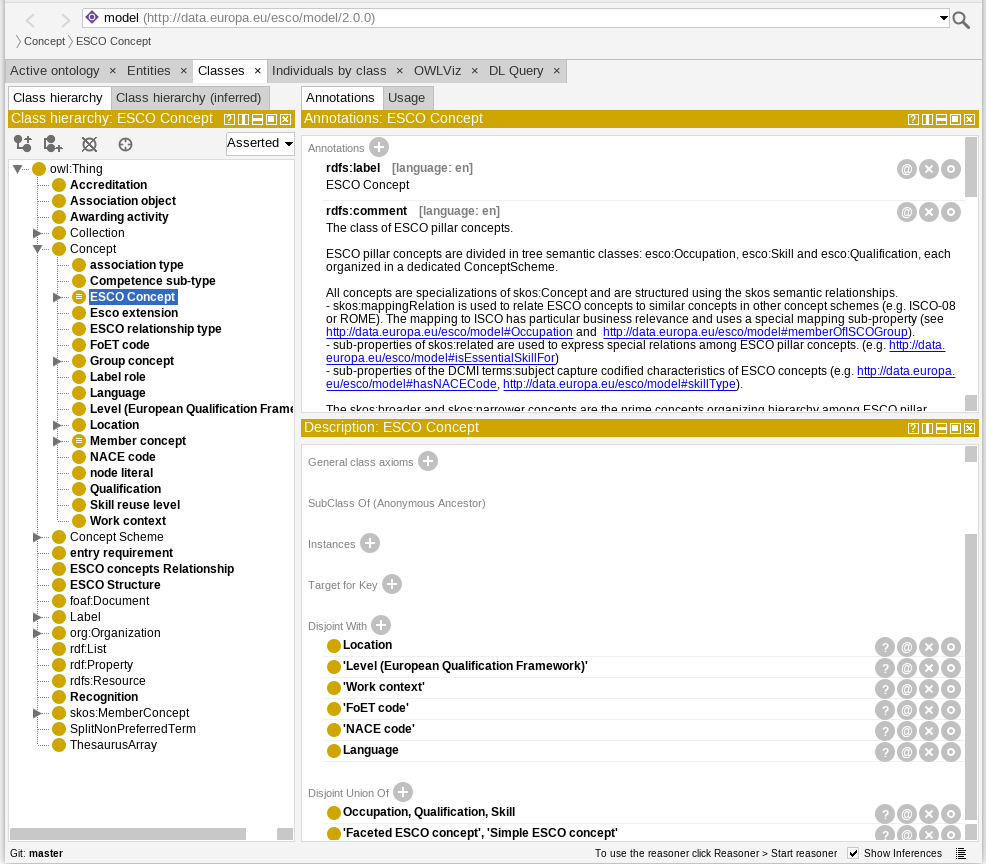
- There is an associated ESCO Ontology, but (as of late 2026) it is in transition, with many deprecated classes. An illustration how it looks is given below (when processing the ESCO ontology within Protege)
Building a Digital Sustainability Competences Ontology
We turn now towards consolidating the learnings from the above overviews, taking into account the specificities of the D4S framework itself. We start shaping an OWL based ontology that will aim to absorb and model the main structural features into a knowledge base. An important observation is that D4S is a comprehensive methodology that is linking roles, competences, outcomes, curricula, assessments, and certifications. In this sense its scope is richer than the examples we saw above.
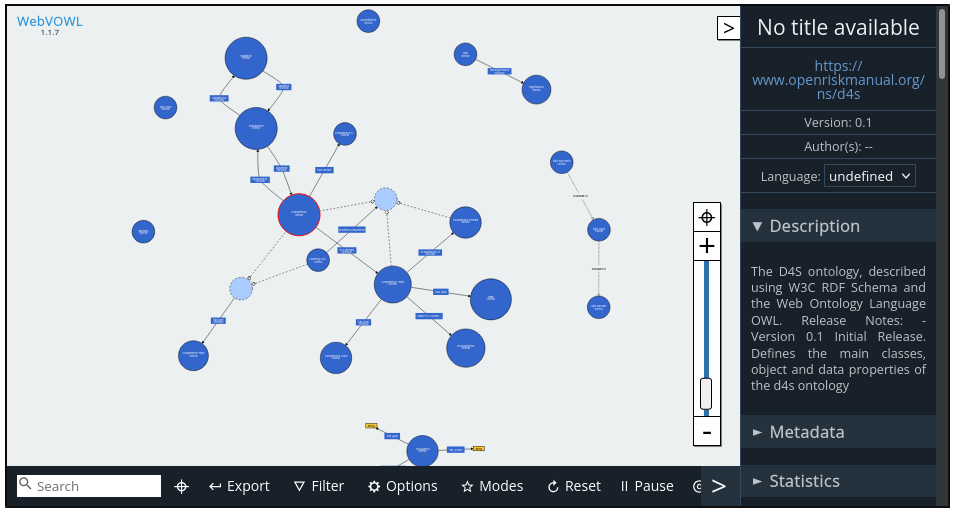
The result can be seen in the first iteration of the ontology, which you can explore interactively online here. Further details in a future post!
References
-
Not to be confused with a similarly named United Nations initiative! ↩︎
-
The twin green & digital transition: How sustainable digital technologies could enable a carbon-neutral EU by 2050 ↩︎
-
To Find Out More Visit the official Digital4Sustainability website where you can learn more about the Alliance Community and how you might get involved. ↩︎
-
greenComp: the European sustainability competence framework, JRC 128040 2022; EUR 30955 EN; doi:10.2760/13286 ↩︎
-
The European Sustainability Competence Framework (GreenComp) in Light of TIMSS 2023 Data, Paulína Koršňáková, Tahira Ali Qadri, and Wangqiong Ye ↩︎
-
e-CF: the European e-Competence framework ↩︎